Whether developing an Environmentally Preferable Purchasing Program (EPP) or looking to transition specific contracted products and services to a new sustainability-focused approach, there are challenges to address. Pulse is here with a look at a successful initiative that provides a useful example of how to prioritize sustainability while lowering costs.
Challenges
Among the major challenges that procurement officials face when developing green purchasing initiatives are:
- Limited market for environmentally preferable products/services.
- Eco-friendly products/services may be more expensive.
- A lack of education and technical assistance to help buyers develop or transition to green contracting programs.
Solutions
Cooperative Purchasing for Sustainability
Cooperative purchasing is a perfect complement to a green purchasing initiative. The NIGP Dictionary of Procurement Terms defines environmentally preferable procurement as “an attempt to address environmental challenges by taking advantage of the government’s vast procurement power to create strong markets for environmentally friendly products and services.”[i] Governments can leverage their purchasing power to create favorable market conditions for sustainable purchasing. State governments can develop indefinite quantity contracts for eco-friendly goods and services and offer them as statewide contracts for piggy-backing or take the lead role in a multi-state cooperative contract with multiple suppliers. Such approaches leverage purchasing power for maximum market effect.
Third Party Certification for Sustainability
One important tool for achieving sustainable purchasing goals is the use of independent third-party multi-attribute certifications. These ensure that the environmental claims and the product performance have been tested and certified by a legitimate, nationally recognized certification program. By removing the analytical burden from purchasers to ensure that products are both effective and safe for use, these certifications save valuable time and resources in the development process. The certifying organizations provide readily available manufacturing and production data for the products, while helping to avoid deceptive practices like greenwashing and fibbing. The certifiers’ registries of qualified products can be the the basis of an approved products list for the contract, and ultimately simplify the jobs of both purchasers and users. Some of the widely-used certification labels for sustainability are:
Case Study: Massachusetts’ FAC85
The Commonwealth of Massachusetts Operational Services Division (OSD) implemented cooperative contract FAC85 Environmentally Preferable Cleaning Products, Programs, Equipment and Supplies in March of 2015. Available statewide, the cooperative purchasing opportunity was also extended to Connecticut, New York, Rhode Island, New Hampshire, Pennsylvania, and Vermont.
When developing the contract, the key objectives that the procurement team sought to achieve included:
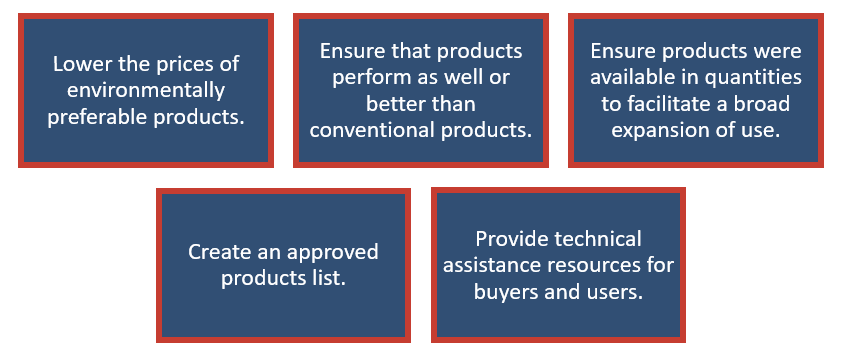
Key features of the cooperative contract include the ability to add or remove products from the contract as necessary and the use of third-party industry certifications to evaluate and determine qualifying products. The three primary certification labels used for FAC85 are Green Seal, Eco Logo and Safer Choice.
FAC85 includes 18,000 products with an average discount range between 20% and 47% off MSRP which achieved cost reduction in addition to the environmental and health savings.[ii] Frontline services improved, and cost savings increased due to the requirement that supplier staff provide on-site assessment and training to the contracting users on the effective use of the new products, dilution rates, and portion control. Beyond the fiscal savings, the contract creates multiple environmental and health savings in reduced energy and water use, less toxic exposure, and an increase in use of recycled content.[iii]
Suppliers submit quarterly and annual sales data to OSD which provides the purchasing data for spend analysis. OSD uses this data, along with data from contract participants to calculate performance, fiscal savings, and environmental impacts.
According to Julia Wolfe, EPP Director for OSD, spending on FAC85 eclipsed $20M in FY2020, and certified environmentally preferred cleaners now occupy approximately 30% of the market in Massachusetts.
Bringing it Home
Building upon existing foundations and examples simplifies the development process and makes it much more feasible for a procurement office to implement their own green contracts or programs. OSD partially modeled their contract after a similar one issued by the states of Oregon and Washington. The approved-products list was modeled after one developed by the San Francisco municipal government.
The use of third-party certifications takes much of the product analysis and evaluation efforts out of the hands of the procurement office and provides technical specifications for the development of solicitations. Model language for terms and conditions are also often provided by certifying agencies or could be modeled after existing contracts like FAC85 that are in place elsewhere. Depending upon the location or size of the purchasing entity and statutory requirements, they may be able to simply join an existing cooperative contract for these products and services.
There are many resources available for states interested in creating their own contracts like FAC85 or signing on to some existing cooperative contract opportunities. Informational resources to aid in the development of environmentally preferable contracts can also be found through the Responsible Purchasing Network and the Sustainable Purchasing Leadership Council.
___________________________________________________________________
[i.] National Institute for Government Purchasing. “Dictionary of Procurement Terms.” Nigp.org, 2020, www.nigp.org/dictionary-of-terms?letter=e.
[ii.] Massachusetts, Operational Services Division, Environmentally Preferable Products Strategic Sourcing Services. EPP Procurement Program Annual Report for Fiscal Years 2017- 2018, 2018. www.mass.gov/doc/2017-2018-annual-report-ma-epp-program-0/download.
[iii.] Massachusetts, Operational Services Division, Environmentally Preferable Products Strategic Sourcing Services. EPP Procurement Program Annual Report for Fiscal Year 2019, 2019. www.mass.gov/doc/2019-annual-report-ma-epp-program-0/download.